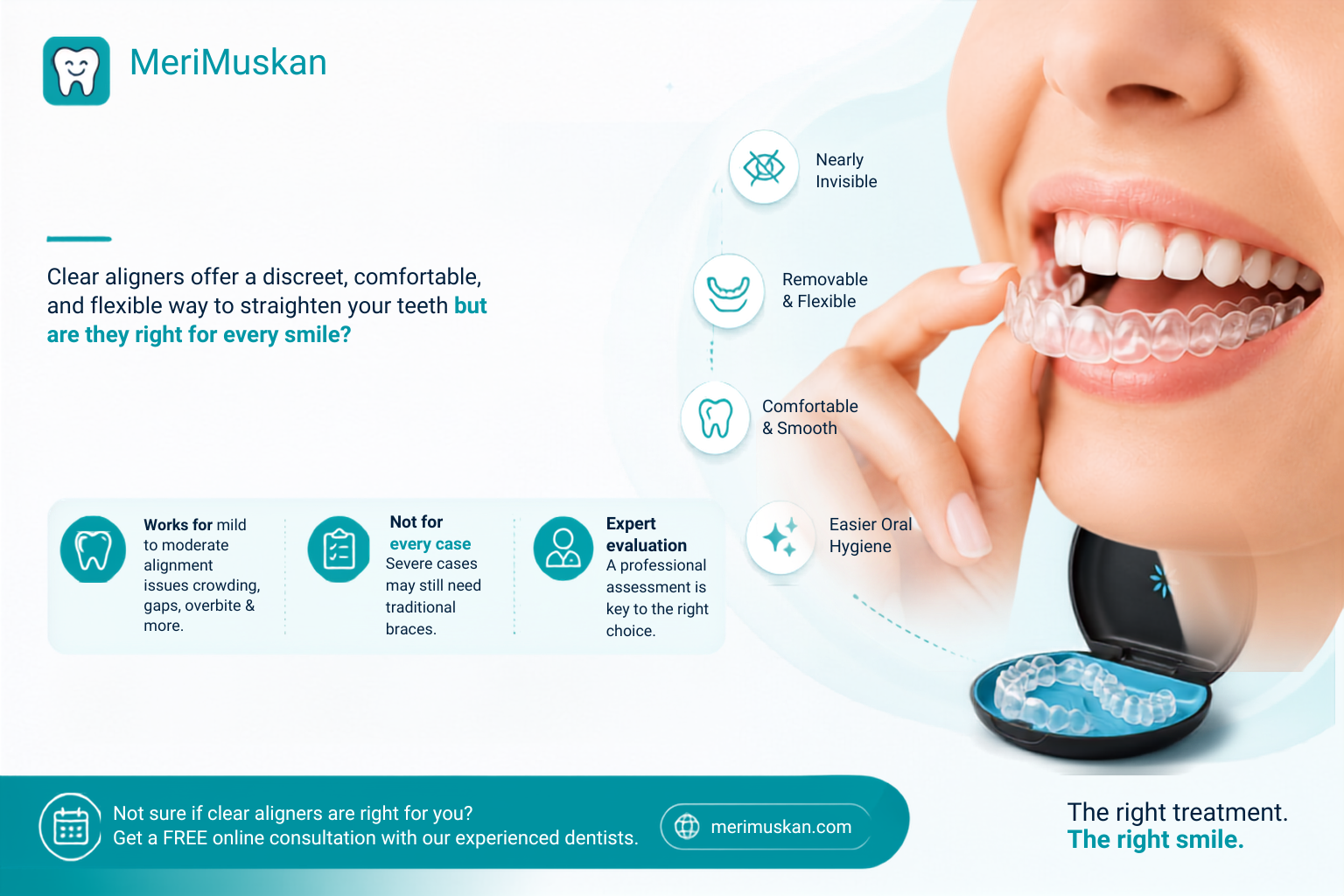
Tired of the idea of metal wires and brackets?
But still want to straighten your teeth?
Clear aligner therapy might be the solution you’ve been looking for. It is most widely known through brands like Invisalign and has moved to a mainstream treatment choice over the past decade. And in Pakistan, more people than ever are starting to consider it.
Since clear aligners are nearly invisible, removable, and do not carry the dietary restrictions or hygiene challenges that come with fixed braces, the interest is understandable.
But the real question is, are clear aligners/they suitable for you?
It is to be understood that clear aligners are not a one-size-fits-all solution. Understanding who they work well for, and who they do not, will save you time, money, and disappointment!
How clear aligners actually work?
You must have wondered how a set of clear plastic trays can move and straighten your teeth?
But the science behind it is precise.
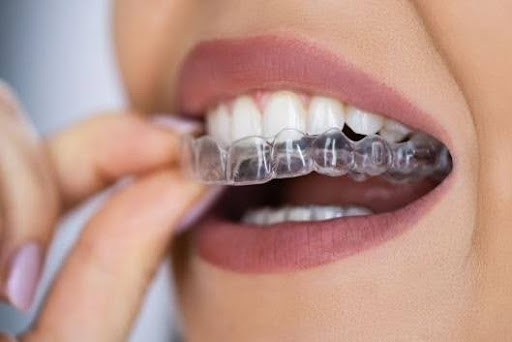
Clear aligners, sometimes also known as, Invisible braces, are custom-made, removable transparent trays that fit snugly over your teeth. These are in series where each tray is slightly different from the other. Over time, the sequence of trays applies controlled pressure that gradually shifts teeth into the desired position.
Treatment typically involves wearing each tray for one to two weeks before moving to the next, with the full series spanning anywhere from a few months to well over a year, depending on the complexity of the case.
Made from a medical-grade thermoplastic material, these trays are discreet enough to go unnoticed in everyday conversation, and can be removed when eating, brushing, or flossing.
But here is the part most people underestimate:
Are you disciplined enough to wear them consistently?
The treatment only works if the trays are worn for at least 20 to 22 hours a day (sometimes slightly less depending on the case). Patients who remove them frequently and do not wear them regularly will not achieve the expected results.
Cases where clear aligners work well
Clear aligners have expanded significantly in their range of treatable conditions. They can be used to treat a wide variety of mild to moderate orthodontic problems.
They work particularly well for:
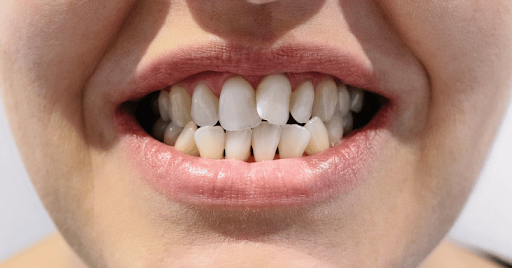
Mild to moderate crowding. Teeth that overlap slightly or are pushed out of alignment due to insufficient space can be corrected very effectively with clear aligners.
Spacing and gaps. Gaps between teeth, including the central gap called diastema, respond well to clear aligner treatment.
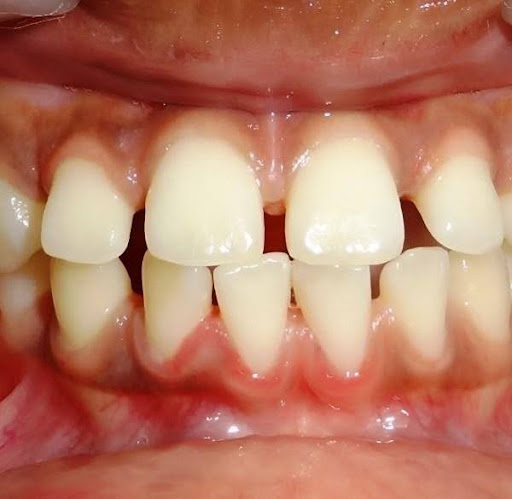
Mild overbite and underbite. Early-stage bite discrepancies that do not involve significant skeletal involvement can be addressed without administering fixed appliances.
Relapse after previous orthodontic treatment. Adults who had braces as children and have seen some shifting over the years are often very good candidates for clear aligners to re-establish alignment.
Clinical evidence supports this.
Studies show that clear aligners are clinically effective for mild to moderate malocclusion, with higher patient satisfaction compared to fixed appliances, largely due to comfort and aesthetics. ¹
So, how to know which option suits you?
The most accurate answer always comes from a proper clinical assessment. This includes:
A detailed examination
Radiographs (such as OPG and cephalometric X-rays)
Bite evaluation
Intraoral and profile photographs
A treatment plan based on photographs alone is not enough.
That said, you can get a rough idea:
The only way to know whether clear aligners are right for your specific case is through a clinical assessment. This involves examining your teeth, taking radiographs (a full mouth x-ray – OPG and cephalometric) to assess teeth and bone conditions, and evaluating bite plane. Profile images and intra-oral images with proper retraction and angulations are also recorded. A treatment plan that is based on photographs alone, without a clinical examination, is not sufficient.
However, you can always have a quick check yourself as well.
Clear aligners may suit you if:
“I have small gaps.”
“My teeth are slightly crowded.”
“I had braces before, but my teeth shifted.”
Braces may be better if:
“My jaw feels misaligned.”
“My teeth are severely rotated.”
“I might not wear aligners consistently.”
A smarter first step
If you’re unsure where you stand, you don’t always need to start with a clinic visit.
Platforms like MeriMuskan offers free online consultations and allow you to share images of your teeth and receive a professional opinion remotely. It’s not a replacement for an in-person orthodontic assessment but it gives you a clear starting point and helps you understand your options before committing to treatment.
The takeaway
Clear aligners offer a modern, discreet way to straighten teeth, but they’re not for everyone.
The right treatment depends not just on your teeth, but also on your lifestyle, discipline, and the complexity of your case.
Choosing wisely isn’t about following trends; it’s about finding what works best for you.
References
Ke Y, Zhu Y, Zhu M. A comparison of the effectiveness of clear aligner treatment and fixed appliance treatment for mild and moderate crowding cases. European Journal of Orthodontics. 2019;41(2):111-116.
Rossini G, Parrini S, Castroflorio T, Deregibus A, Debernardi CL. Efficacy of clear aligners in controlling orthodontic tooth movement: a systematic review. Angle Orthodontist. 2015;85(5):881-889.
Zheng M, Liu R, Ni Z, Yu Z. Efficiency, effectiveness and treatment stability of clear aligners: a systematic review and meta-analysis. Orthodontics and Craniofacial Research. 2017;20(3):127-133.