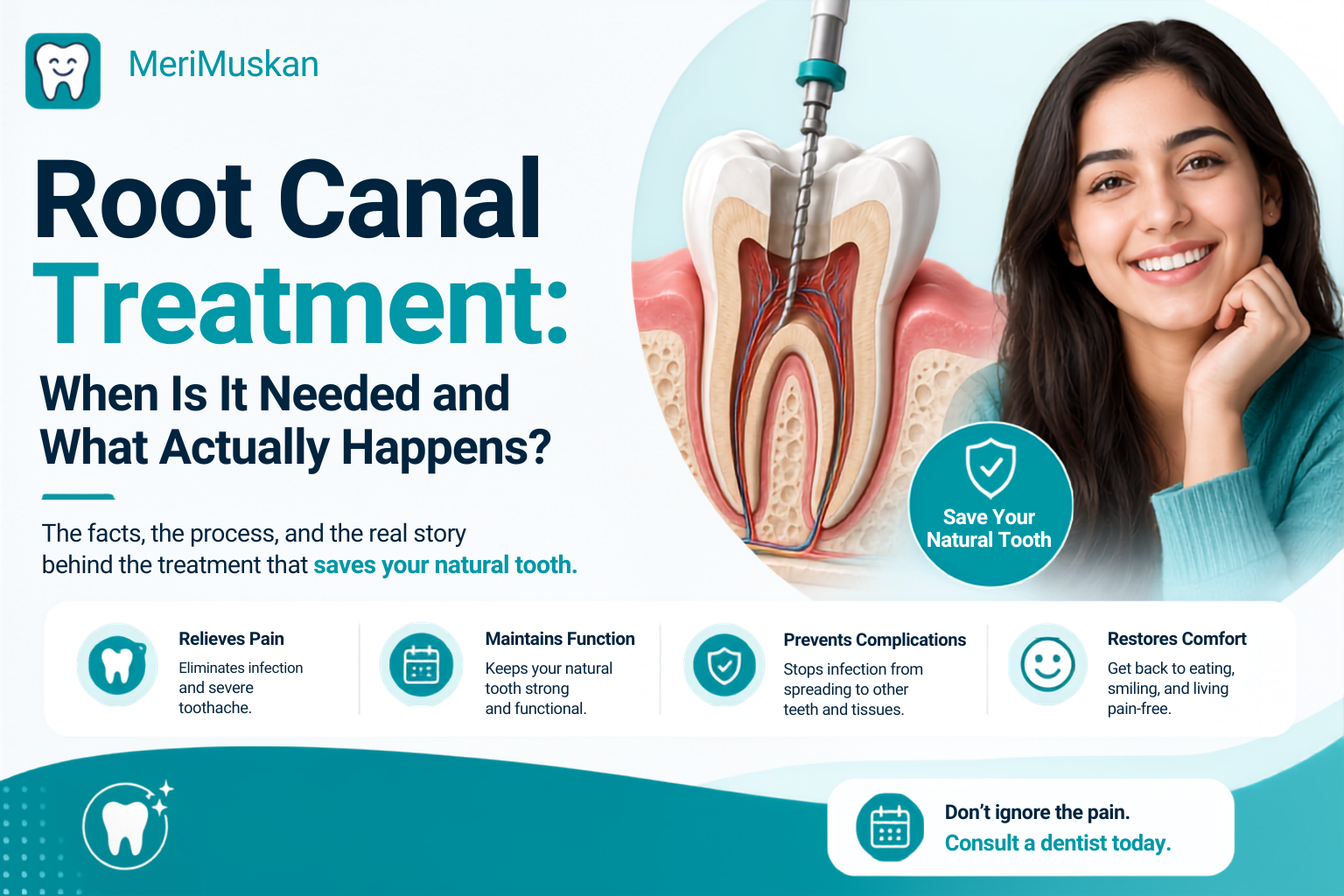
RCT…
The word patient fears the most.
But are they really as bad as every patient thinks?
Imagine Zara, who had been ignoring a toothache for three weeks.
It started as mild sensitivity to cold water, the occasional sharp zing. Not enough to worry her. She told herself it would pass.
She took some medicines to resolve the pain. Some days felt better. Most didn’t.
Then the pain changed.
It became constant. Sharp. Unavoidable.
Eating on that side was impossible. She hadn't slept properly in days.

That’s when she finally decided to visit a dentist.
Her dentist took a look and said: "You need a root canal."
And just like that.. Zara’s fear kicked in.
She had heard the stories.
The pain. The horror. The endless appointments.
Here's what nobody had told her, most of that fear was based on outdated information.
So, what is a root canal in simple terms?
Every tooth has a soft inner core called the pulp. This is the living part, which contains nerves and blood vessels. When this pulp becomes infected or severely damaged, it can cause intense pain and threaten the tooth, leading to infection.
A root canal is simply the process of removing that infected pulp, cleaning the inside of the tooth, and sealing it so the tooth can remain in your mouth functional and pain-free.
In short, it saves your natural tooth.
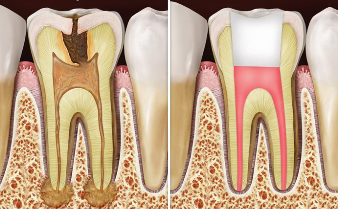
When is a root canal actually needed?
Not every toothache needs a root canal.
Here's when it typically becomes necessary:
Deep decay that has reached the pulp (often from an untreated cavity)
A cracked or fractured tooth that exposes the inner nerve
A tooth injury, sometimes even one that didn't break the tooth visibly
An abscess or infection at the root of the tooth
Common signs you may need a root canal treatment:
Prolonged sensitivity to heat or cold that doesn't go away
Spontaneous or severe toothache
Swelling or tenderness in the nearby gum
Pain that keeps you awake at night
Tooth darkening or discoloration
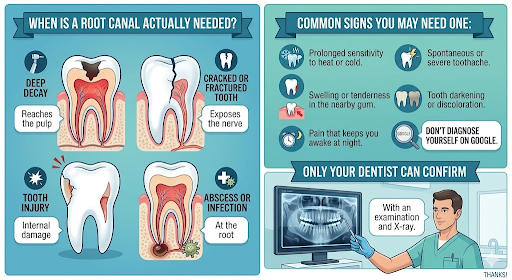
With that said only your dentist can confirm this with an examination and an X-ray if you actually need one.
Don't diagnose yourself on Google. Thanks!
Fear vs. Reality: what the procedure actually looks like
Let’s address the biggest myths.
Fear: "It's going to be extremely painful."
Reality: The procedure is performed under local anaesthesia. Most patients report feeling pressure or movement but not pain. In fact, the root canal relieves the pain that brought you in.
Fear: "It takes forever and many appointments."
Reality: With the advances in dentistry, most root canals are completed in one to two appointments. Simple cases are often done in a single sitting of 60–90 minutes. Complex cases or teeth with multiple roots may require a follow-up.
Fear: "My tooth will never feel normal again."
Reality: After the root canal, the tooth is typically restored with a crown that looks and functions like a natural tooth. Once you get used to it, most people cannot tell the difference. Treated teeth can last for decades with proper care.
Fear: "There will be a long, painful recovery."
Reality: Some mild soreness and sensitivity for a few days after the procedure is normal. Over-the-counter pain relief usually handles this easily.

What happens step by step?
Here is what goes on in a root canal treatment:
Step 1: Anaesthesia
Your dentist numbs the area with a local anaesthetic. This is the part most people fear, but it is a small injection, and within minutes, you feel nothing in that area.
Step 2: Accessing the tooth
A small opening is made at the top of the tooth to reach the pulp inside.
Step 3: Removing the pulp
The infected or damaged pulp is carefully removed using instruments. The canals inside the root are cleaned and disinfected.
Step 4: Sealing the roots
The cleaned canals are then filled with biocompatible material. The tooth is sealed to prevent future infection.
Step 5: Restoration
In most cases, a crown is placed over the tooth to protect it and restore full function. This is usually done in a separate appointment once the tooth has settled.
What happens if you don't get the root canal?
This is the part worth understanding.
An infected tooth does not heal on its own. Without treatment:
The infection spreads to surrounding bone and tissue
Neighboring teeth become at risk
Pus can form, which is far more painful and serious
In severe cases, infection can spread beyond the mouth, sometimes even in the neck region.
If ignored for a long time, the tooth will eventually need to be extracted
And…
Extracting a tooth is not the end of the story. It creates new problems around teeth alignment, chewing, and bone health, often requiring implants or bridges that cost significantly more than the root canal would have.
Avoiding the root canal doesn't make the problem go away. It makes it bigger, complex, and costly!
The takeaway
Modern dentistry has made root canal treatments routine, manageable, and less complex. If you have been told you need one, or if you have been sitting on a toothache hoping it disappears, please don't wait.
Remember, dental problems do not go away without treatment; they only become costly and complex with each passing day.