Your wisdom tooth starts hurting.
At first, it's just a little uncomfortable.
You think:
"Maybe it's because I haven't slept properly."
A day later, your gum feels swollen.
Then chewing becomes uncomfortable.
And suddenly, opening your mouth feels difficult.
Sound familiar?
If you're experiencing wisdom tooth pain, you may be wondering:
"Is my wisdom tooth infected?"
Not every painful wisdom tooth is infected, and not every wisdom tooth needs to be removed.
So, let's break down what could actually be happening.
First, why do wisdom teeth cause problems?
Wisdom teeth are the last set of molars to develop, usually appearing in the late teens or early twenties.
Sometimes there simply isn't enough room for them to come through properly.
A wisdom tooth may become:
Impacted underneath the gum
Partially erupted
Angled toward another tooth
Trapped against the surrounding bone or tooth
Difficult to clean properly
And when part of the tooth is covered by gum tissue, food and bacteria can become trapped around it.
This can lead to inflammation or infection around the wisdom tooth, often called pericoronitis.
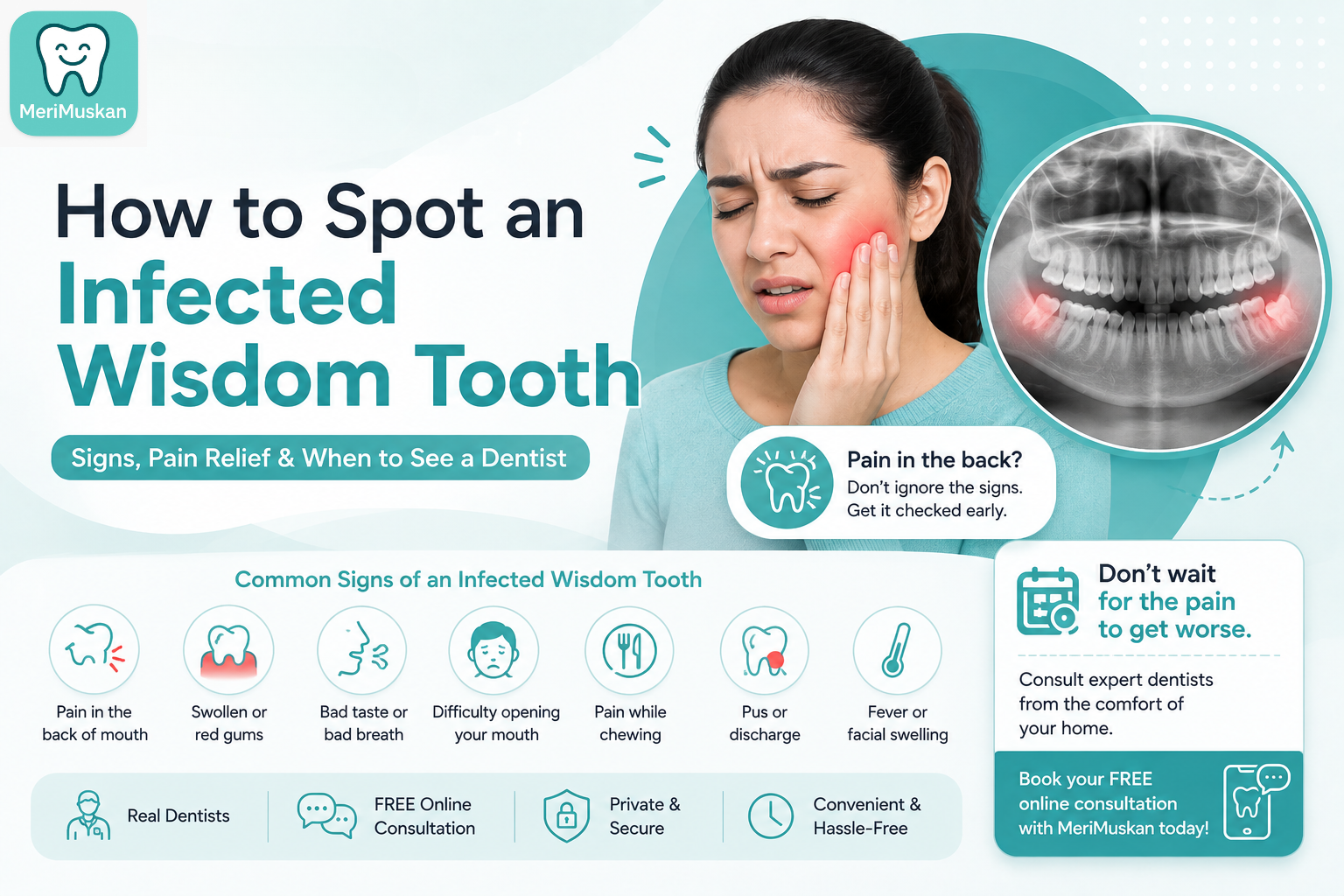
What are the signs of an infected wisdom tooth?
Here's where you should pay attention.
1. Pain around the back of your mouth
You may experience pain or tenderness around the last tooth at the back of your jaw.
The pain can sometimes spread toward the jaw, ear, or nearby areas.
2. Swollen or red gums
Look behind your last molar.
Does the gum look:
Red?
Swollen?
Tender?
Puffy around the wisdom tooth?
These can be signs of inflammation.
3. Bad taste or bad breath
Have you noticed a persistent bad taste in your mouth or unusually bad breath?
Food and bacteria trapped around a partially erupted wisdom tooth can contribute to this.
4. Difficulty opening your mouth
This one shouldn't be ignored.
If swelling around the wisdom tooth makes it difficult or painful to open your mouth, you should have it assessed by a dentist.
5. Pain when chewing or swallowing
Inflammation around the back of the mouth can make chewing uncomfortable.
Some people may also experience discomfort when swallowing.
6. Pus or discharge
If you notice pus around the gum near your wisdom tooth, that can indicate infection and should be evaluated professionally.
7. Fever or facial swelling
This is particularly important.
Fever, significant facial swelling, worsening pain, or difficulty swallowing or breathing requires prompt dental or medical attention.
Don't simply wait for it to disappear.
But here's the confusing part...
Does every wisdom tooth need to be removed?
No.
This is one of the biggest misconceptions about wisdom teeth.
A wisdom tooth doesn't automatically need extraction simply because it exists.
If a wisdom tooth is healthy, properly positioned, functional, and can be kept clean, your dentist may recommend monitoring it instead.
Extraction may be considered when a wisdom tooth is causing problems such as:
Repeated infections
Significant decay
Damage to the neighbouring tooth
Gum problems
Cysts or other pathology
Impaction causing ongoing problems
Your dentist may recommend an X-ray, such as an OPG, to understand how the wisdom tooth is positioned before deciding what to do.
What can you do for wisdom tooth pain relief?
If your wisdom tooth is hurting, you may be tempted to search:
"How to get rid of wisdom tooth pain fast?"
There are some measures that may temporarily make you more comfortable, such as maintaining gentle oral hygiene around the area and following appropriate over-the-counter pain-relief guidance if it is safe for you.
But here's the important part:
Pain relief is not the same as treating the cause.
If an infection is present, simply making the pain disappear doesn't necessarily solve the underlying problem.
And don't put aspirin directly on your gums or use random substances recommended by viral social-media "dental hacks." They can irritate or damage the tissue.
If the pain keeps returning, it's time to find out why.
Quick self-check: Could your wisdom tooth be infected?
Ask yourself:
Is the gum around my wisdom tooth swollen?
Does it hurt when I chew?
Do I have persistent bad breath or a bad taste?
Is there pus around the tooth?
Is it difficult to open my mouth?
Have I had wisdom tooth pain before?
Is the pain getting worse rather than better?
If you answered yes to several of these, don't ignore it.
A dentist can examine the area and determine whether you're dealing with inflammation, infection, impaction, decay, or another problem.
So, when should you see a dentist?
Don't wait until the pain becomes unbearable.
It's especially important to seek dental care if you have:
Severe or worsening pain • facial swelling • fever • pus • difficulty opening your mouth • difficulty swallowing
A dentist may examine the wisdom tooth and recommend an X-ray to assess its position and the surrounding structures.
The treatment depends on the cause.
Sometimes it's simply a matter of cleaning and monitoring the area.
In other cases, treatment of the infection or wisdom tooth extraction may be necessary.
Not sure what's causing your wisdom tooth pain?
You don't have to diagnose it through Google.
MeriMuskan offers FREE online dental consultations with experienced dentists.
You can share your dental concern and relevant photos with our dentists from the comfort of your home and get guidance on what you should do next.